
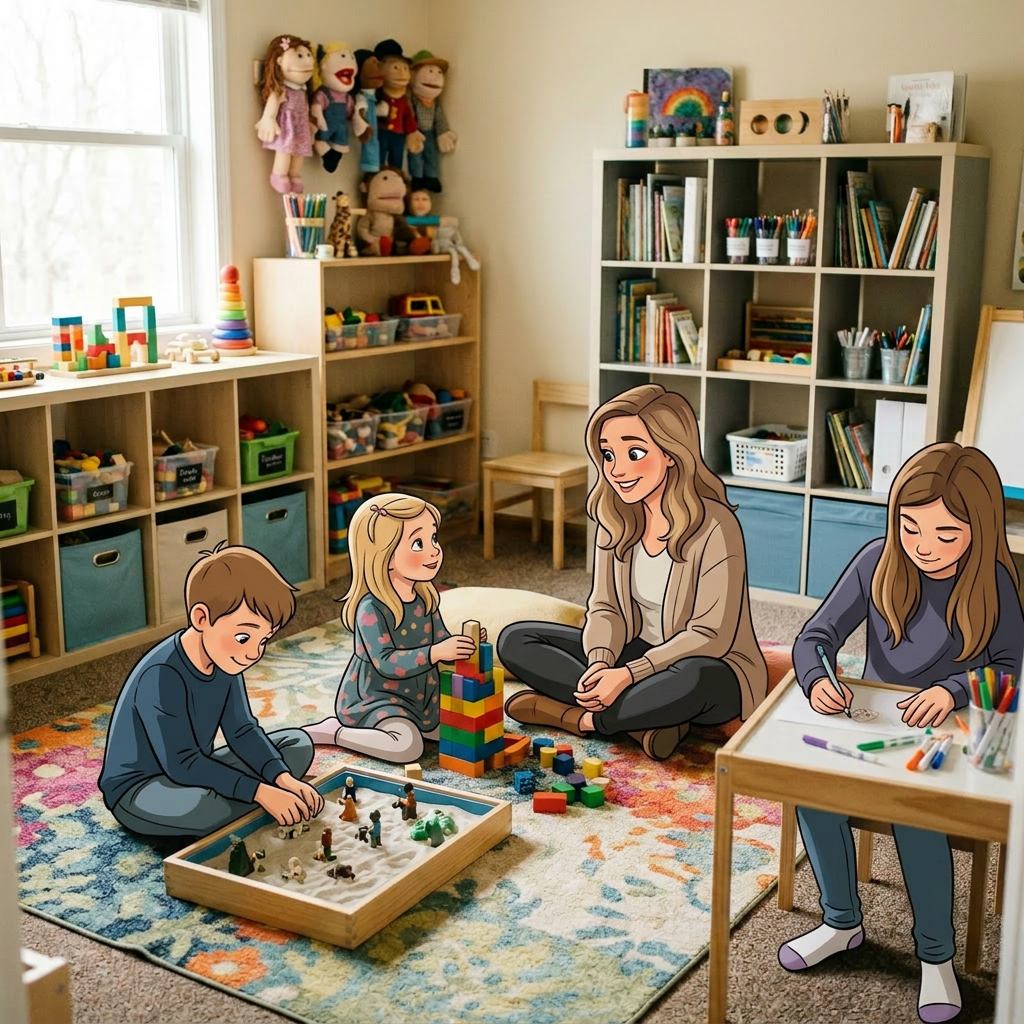
Play is essential for our children; playing with your children gives them a sense of importance, inclusion, and understanding.
Play Therapy is so much more than play. It can involve art, water, or building blocks. It is also free play. When children play, we begin to see ourselves reflected in their play. They will mimic adults, older siblings, or playmates in their lives. Through these activities, if you provide the child with a kitchen set, babies, and some equipment (not necessarily much), you can observe how they express affection, attachment, anger, or disappointment.
Given the space to play without interference, play therapy becomes essential. By sitting back and letting the child choose any toy, play however they like, and speak freely, you gain insight into their minds, emotions, and environments at home or at school. This approach also reveals the child’s needs.
Play Therapy can also be directed. In this approach, the therapist or parent encourages the child to play with specific items, such as a game, an art project, building blocks, Lego, or time outdoors. This method helps to observe how the child responds to new ideas, games, or directions.
A specialized type of Play Therapy called Theraplay focuses on attachment. In Theraplay, the adult leads and may film or video the session. The parent participates in all sessions, fostering connections between both parties. Theraplay techniques can be used at home to build these attachments or bonds. It is important to practice the suggested skills regularly.
Theraplay considers the child’s emotional age to build attachment. This is similar to inner-child work but applied with children or teens. Theraplay relies on eye contact, structure, listening, following directions, and waiting for the adult’s cue.
Some ideas for this bond building are:
- Putting lotions in your hands and rubbing them on the child with a silly song or something exaggerated as you try to hold on, but can’t, so you fall because the child is so slippery.
- Have stress balls or beanbags, and ask the child to bounce them on his knee, foot, elbow, or head. They cannot start until you look at them and say, “Go.”
- Using an old newspaper and letting the child Karate chop it. Again, the key is to wait, make eye contact, and then go single. After all the paper is chopped, you both crush the papers into balls as fast as you can to see who has more paper wads. Next, throw the paper into a bin like you would a basketball into a hoop.
- All children love balloons. You would take a balloon and see how long you can keep it up. As the child is only to catch or keep it in the air with the head, feet, or other parts of the body, not with the hands.
A key aspect of therapy and attachment is attunement—learning to look at each other, read the child’s needs, and build comfort. Songs support this process. Round songs provide an interactive way to start, and the child joins in when you point to them.
Theraplay incorporates components of Occupational Therapy, including spinning, balancing, writing, painting, and jumping. Each activity supports mobility, sensory, and proprioceptive development. In each session, you have an Opening and a closing. Fun ways to enter and exit the room. With these activities, you add structure and fun. These activities are three-legged race, acting like an airplane, hopping, wheelbarrow-style walking, and crawling like a specific animal, sounding like a specific thing. It is fun and an easy way for your child to transition from one room to another or from one event to another.
- One last fun idea: toco, barrito, pizza, not eating them, but wrapping the child up tightly (head out!) and acting like you are making these things. It gives the child a deep-pressure massage and allows them time to relax in a fun way.

Using the 10 -minute rule for Therapy
Jerry runs into the therapist’s office, screams as he throws himself on the floor. “You will take my toys away…

Building Working Memory
Games for increasing Working Memory 1. Have your child be the teacher. Let them tell you how to complete their…

