
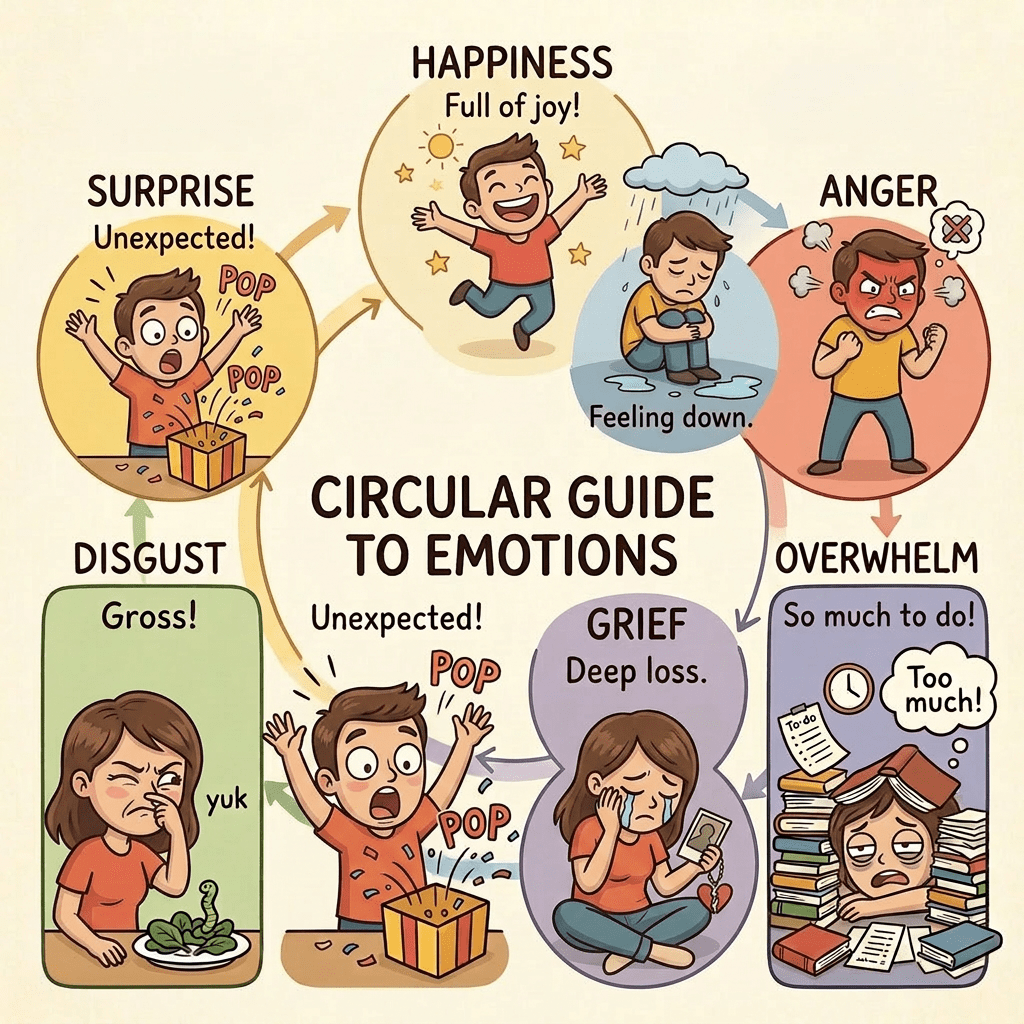
Understanding how emotions work and how to identify them helps with responding to or behaving in response to them. Emotions are usually divided into two main types: primary and secondary. Primary emotions are basic feelings that everyone experiences, such as fear, happiness, and sadness. These are immediate reactions to events and are recognized worldwide. Secondary emotions are more complicated and develop in response to our primary emotions. They are shaped by our thoughts, experiences, and social surroundings. For example, anxiety is a secondary emotion that often comes from feeling fear. Psychologists say there are six primary emotions that all other emotions come from. (Ma, 2024) These six are universal and found in every culture.
The six primary emotions are fear, joy, surprise, disgust, sadness, and anger. (Cherry, 2024)
Feeling overwhelmed or anxious often means you are experiencing fear. If you can identify the emotion, you can start to change the behaviors that come from it. One helpful way is to ask yourself, “What am I afraid might happen right now?” If you find yourself worrying about what could go wrong or feeling unsafe, you are probably feeling fear. Paying attention to your body can help, too: fear can show up as a racing heartbeat, tense muscles, or a desire to get away. Grief does not always mean feeling overwhelmed, anxious, or fearful, but it can include those feelings. At the start of grief, you might feel stuck and unsure what to do next. You may freeze, unable to act or react, and your mind may struggle to keep up with everything happening.
The responsibility of moving forward, whether in traumatic grief, loss of a loved one, or changing schools, jobs, or homes, may seem daunting, and you may not realize some of those situations are still grief. Grief is loss; it is sadness, and sadness can lead to fear. Since we can have multiple emotions at once, we need to address each one individually and understand the behavior it causes.
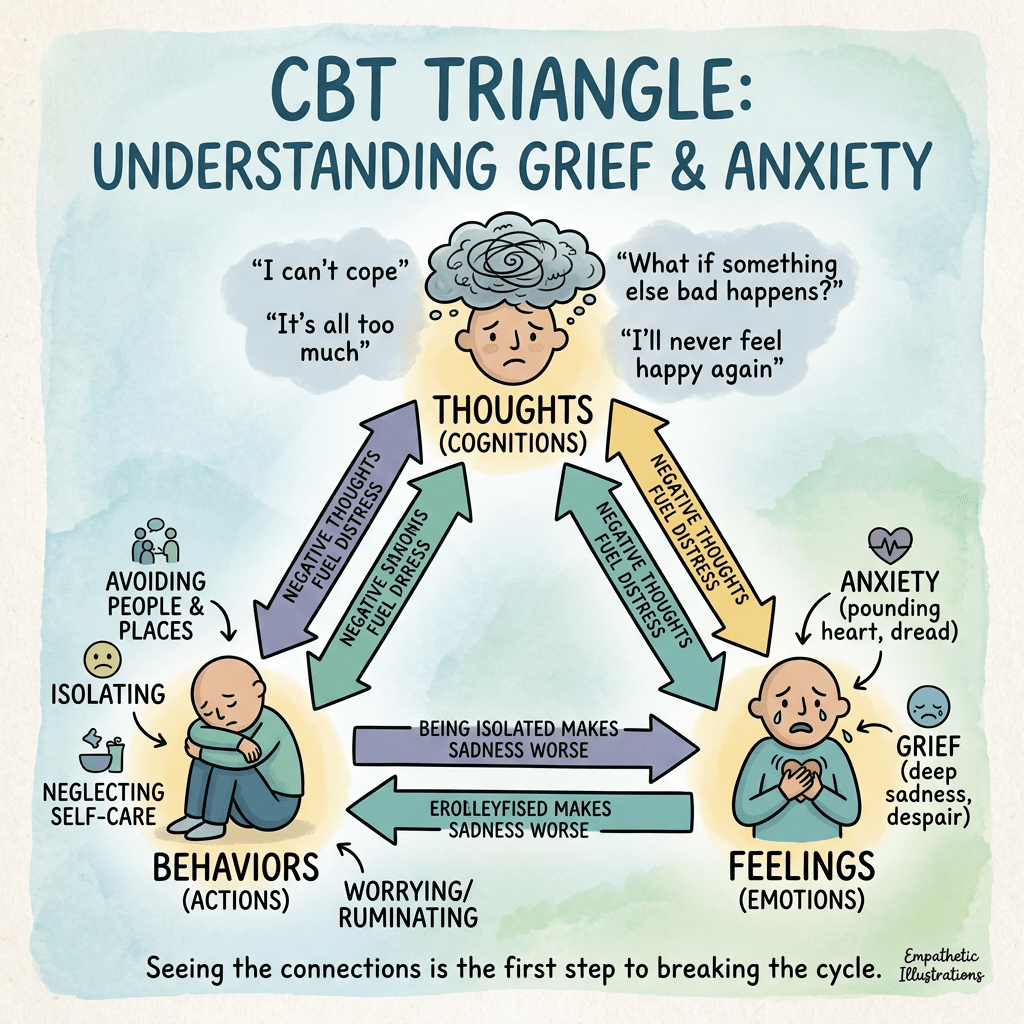
Understanding cognitive therapy and how the triangle works makes it easier to separate emotions from behaviors and behaviors from thoughts. It all works on that triangle: one leg is thoughts, one is emotions, and the base is behaviors. (CBT Triangle | Worksheet, n.d.)
To see how this works in real life, imagine you have an important exam coming up. Your thought might be, “I am not prepared enough and will probably fail.” This thought triggers the emotion of fear or anxiety. As a result, your behavior might include procrastinating, avoiding studying, or having trouble sleeping. Recognizing how your thoughts lead to feelings and then to actions allows you to interrupt this cycle. If you change the thought to, “I have studied before and can prepare for this exam,” the emotion might shift to confidence or determination, and your behavior could become more focused and calm.
Anything can trigger this reaction; any action has an equal and opposite reaction. High emotions lead to high behavior. If you are feeling, not thinking, that you are in danger, you will have an automatic fight-or-flight response. (Editors, n.d.) You may react before you think.
As related to grief and the loss of a loved one, your grief is a rollercoaster; you may be sad for a long time, with bouts of anger or fear depending on your day-to-day events and activities. This can lead to thoughts that trigger emotions, which in turn lead to behaviors such as racing, tears, shaking, and shutdowns. All are responses to the thoughts and emotions you are dealing with.
To help manage this process, you can follow these steps:
1. Pause and notice what you are feeling in your body and mind.
2. Identify and name the emotion you are experiencing (for example, sadness, anger, or fear).
3. Trace back to the thought or situation that triggered the emotion.
4. Ask yourself if there is another way to view the situation or thought.
5. Choose a helpful thought to focus on, even if it is something small or positive.
6. Notice how your emotions shift and observe any changes in your behavior.
Once you can identify the thought, use thought-stopping, then the emotion will be less intense or may even shift from fear to surprise. Now you can deal with the event or trigger because you have better control of your emotions.
A lot of the time, we say, “I feel…” when we actually mean “I think…”
If you think of grief or loss as more than death, you can break it down more easily to identify what is happening to your mind, body, and spirit. Grief or loss is the idea that you have lost something or have to change something you may have loved. For example, losing a friendship, ending a romantic relationship, or going through a divorce can bring about strong feelings of grief. Experiencing a serious illness, losing a pet, or moving away from a familiar home or community can also cause a sense of loss. Even situations like not making a sports team, losing a job, retiring, or having to let go of a long-term dream are all forms of grief unrelated to death. Going to a new school, starting a new job, or bringing someone new into your life all mean you have lost something that brought you to this new place. New emotions, fear, or feeling overwhelmed may arise; even though you may have wanted to do all the things mentioned, it still brings with it the fear of the unknown.

Listed below are some scriptures for those who may be looking for spiritual guidance with anxiety and grief
For Anxiety:
- Philippians 4:6-7
“Do not be anxious about anything, but in every situation, by prayer and petition, with thanksgiving, present your requests to God. - 1 John 4:18
- Isaiah 41.13
- John 16.33
- Psalm 23.4
- Philippians 4.6
- Luke 12.25-26
- Romans 12.21
- John 14.1
For Grief:
- Psalm 34:18 “The Lord is close to the brokenhearted and saves those who are crushed in spirit.”
- Matthew 5:4
- Revelation 21:4
- Psalm 46:1
- John 14:1
References
Ma, L. (2024). What Are Basic Emotions?. Psychology Today. https://www.psychologytoday.com/us/blog/hide-and-seek/201601/what-are-basic-emotions
Cherry, K. (2024). What Are Basic Emotions?. Psychology Today. https://www.psychologytoday.com/us/blog/hide-and-seek/201601/what-are-basic-emotions
(n.d.). CBT Triangle | Worksheet. Therapist Aid. https://www.therapistaid.com/therapy-worksheet/cbt-triangle
Editors, B. (n.d.). Fight-or-Flight Response. Britannica. https://www.britannica.com/science/fight-or-flight-response


Leave a Reply