
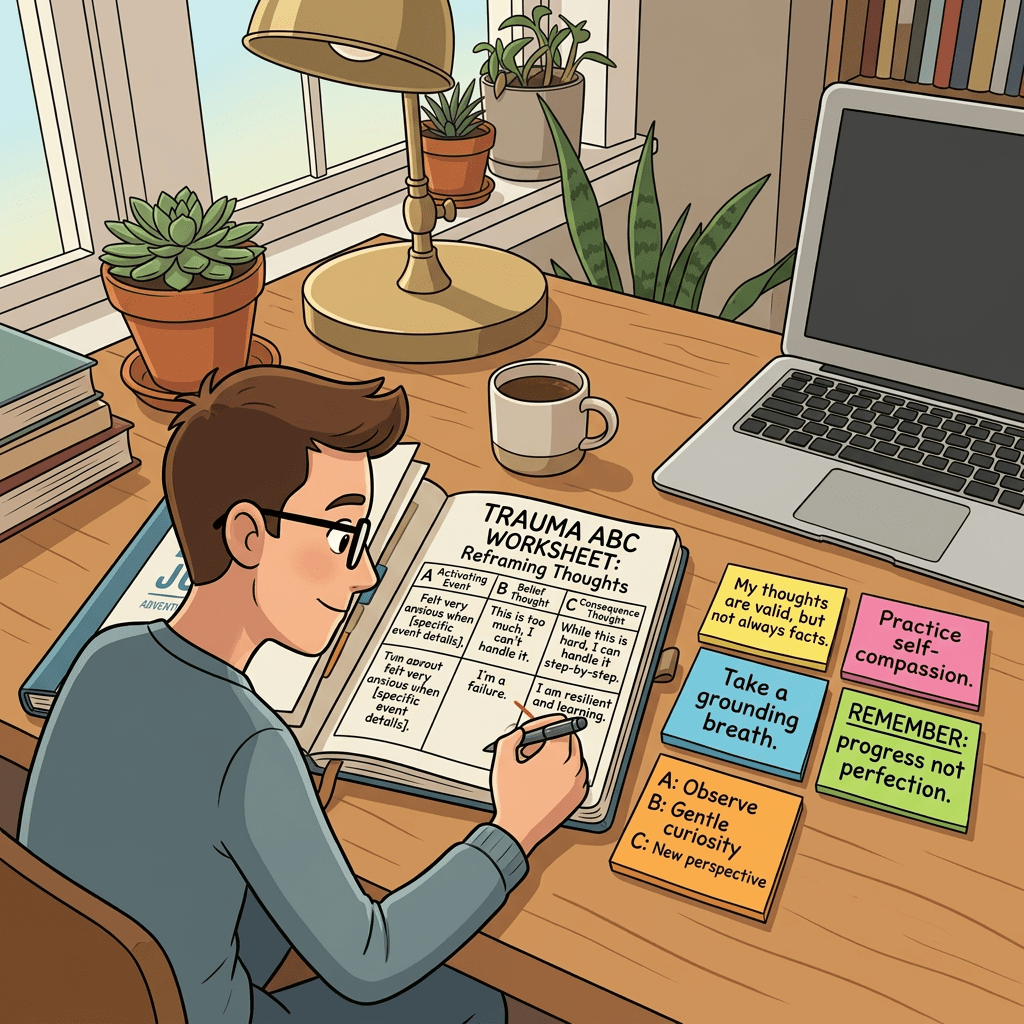
When you begin to work on this ABC for trauma page, you will find yourself not believing the new rational or alternative thought. Remember that it’s ok. It takes time to uproot that stuck point and put in a new thought. The idea is to know that you can have other thoughts; the stuck point is rooted deeply, but it may not apply to every situation. It pops into your head. When we have a stuck point or a thinking error, we tend to bring in everything with that thought. It is not only the situation, but all the situations we have had. Using the ABC page helps you separate the stuck point and situation, and understand the actual emotions and thoughts in the situation.
A. Situation
What happened to cause you to have ruminating thoughts:
Examples: Someone ran out in front of me when I went to the store
I walked into a dark room, and someone came in behind me
B. Stuck point:
What sticking points do you have about this event? How much do you believe your stuck point?
I can not trust anyone
I always mess up
How much do you believe it?
I believe this 100%
C. Emotions
List all the emotions, and remember you can have more than one emotion
List each emotion from 0-100%
You will want to find an emotion wheel or look at the emotions post to be sure you are identifying all the emotions you feel when you have the stuck point.
D. Stuck point questions
Is this thought realistic? Are you carrying over all your fear, trauma, and hurt in this situation and stuck point?
You can go through these questions to see if your stuck point is reasonable or a habit.
- Evidence for and against the stuck point- would it stand up in a court of law?
- Is your stuck point including all the information, is it focused on one piece of information, and/or is it focused on unrelated parts of the story? Is your stuck point focused on the past and not the actual situation?
- Is your stuck point habit? Fact?
- Are you saying absolutes, like all or nothing, extreme, or exaggerated terms? Based on feelings?
- So, where did this stuck point come from?
- Is that person or place dependable? Is your information reliable and reasonable?
- Are you confusing what could happen with what is likely to happen: where is your focus on the 20%, thinking it is 80%
E. Distortions, thinking errors, or problematic thinking
All mean thinking errors
Do you have them in your stuck point
- Minimizing and magnification
- catastrophizing
- overgeneralisation
- magical thinking
- personalization
- jumping to conclusions
- mind reading
- fortune telling
- emotional reasoning
- disqualifying the positive
- should have statements
- all or nothing statements
- always, never, every
F. Reframing or finding an alternative thought
to replace your stuck point.
Reframing your stuck point. An Alternative thought.
What can I say instead of my stuck point?
Can I believe this thought? How much do I believe it is 0-100%
This can take time. You may not believe it, but more than 2%, but it gets you to see that you have the ability to use a different thought for the situation. Also, it helps to change the stuck point.
G. Rate the old stuck point
Look at your stuck point, do you believe it for this situation now? Is that thought reasonable? You may still believe it, and that is ok. It takes time. You can rate your stuck point again. Do you still believe it to the same % for this situation?
H. Emotions
Now you will rate how you feel. What emotions do you have now?
Are they different than before?
Do they have more to do with the actual situation or the stuck point?


Leave a comment