
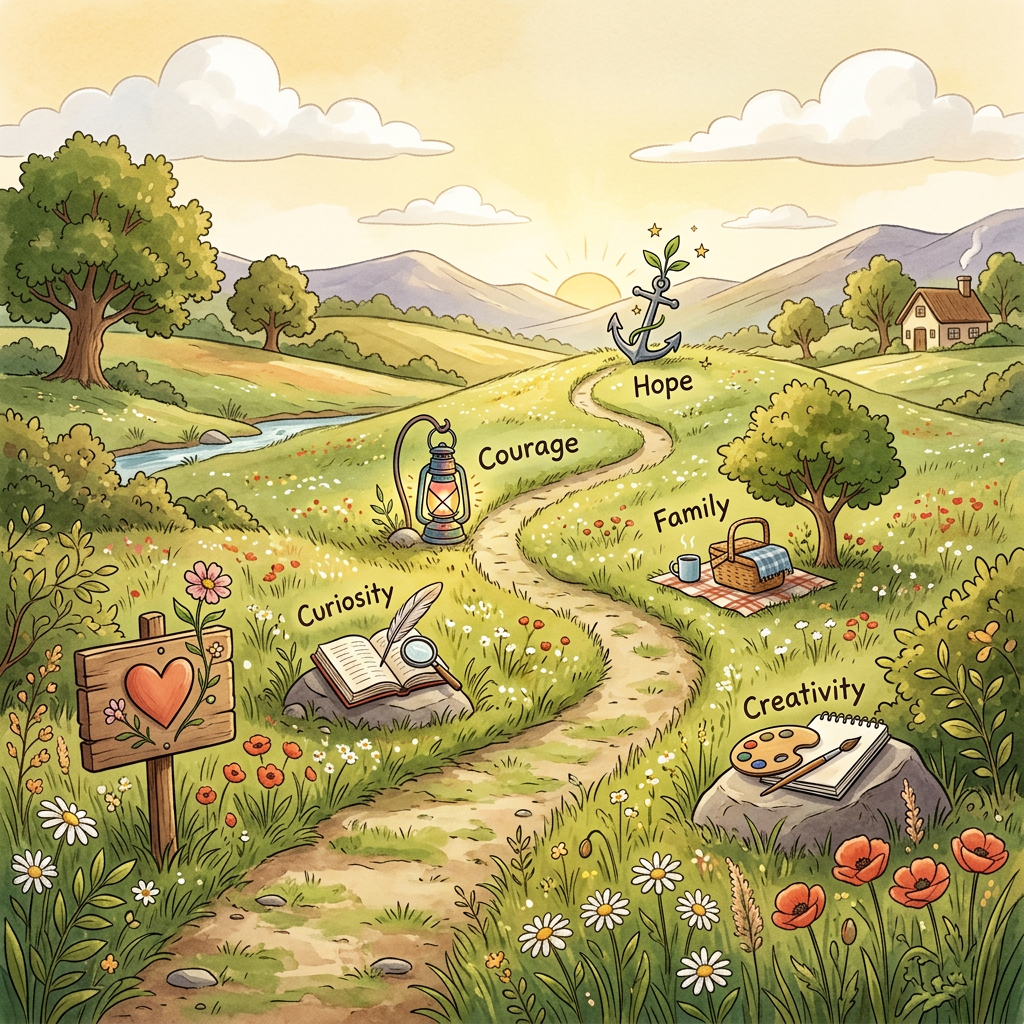
Values and worldview: what matters to me, my beliefs, and how I see the world (helping my inner child have a voice and understanding who I am)
Discovering my personal values
Learning my personal values was a journey in itself. I didn’t know who I was or what I really believed. I professed to be a Christian, so I knew I believed in God, but I was not tied to a religion or denomination. I started a search for what I believe by attending as many different churches and religions as I could in my area. I remember being invited to a Bible study at a friend’s church, where people around the table passionately debated the “right” way to live and which beliefs mattered most. I felt pulled in different directions, not wanting to disappoint anyone or cause conflict, but also unsure if I truly agreed with anyone in the room. That pressure made me realize I still needed to find my own voice and perspective. I realized I liked being a Christian and wanted to attend the Catholic church until I divorced, and then my journey began again. I settled on nondenominational and full gospel. I realized everyone had an opinion and a belief, and they would argue or try to convince me to agree with them.
I had nothing to stand on because I was like a chameleon; I went with the loudest voice, or the person who pushed his agenda the most, because I did not have a voice. My hidden witness (my inner child who saw everything in my life) stayed hidden and didn’t want to voice an opinion and rock the boat. I did have a few things I stood on, and one was child development, which I stood with what I considered the backbone of child development: Jean Piaget, Erik Erikson, and Virginia Axline. (Developmental Stages, Theories of, n.d.) I had one thing to believe in and put all my energy into it. I raised my children in the way and with the words of their modalities. While my children were playing and developing, I realized I was letting my inner child play and have a voice. The idea of child-centered play, and the process that builds emotional strength, self-acceptance, and resolves inner conflict through self-directed play in a supportive, non-judgmental atmosphere, was something I loved for my children but also for myself. (Glover & Landreth, Wilson, 2018, pp. 399-409) n.d.) I would sit and play with them for hours, paint, get dirty, make forts in the living room, take boxes and build, have wars, and make safe homes. This was so new to me; it became what I believed in. So I wanted to learn more, and I went to school to learn child development and psychology.
As my mother always did, when I did anything, she also went to school for an AA degree in child development and opened a daycare. As was her custom, she would live through me or as an extension. Now, I realized she was taking my identity differently. I continued to get my degree, but after the AA in child development and special ed, I went on to receive a double bachelor’s in Sociology/child development and Psychology/special education (neurodiversity). She would tell everyone, ” Well, she is not a doctor, and would say she knew all about attachment theory or anything I would discuss; she went as far as to tell people she knew about the Neurosequential model of therapy because she used it in her daycare. So once again, she minimized me and put herself in this spotlight of lies. I struggled for a long time to find my balance, to find peace, and decide what I knew and believed in.
I always came back to Therapy and child development, but when I learned about attachment theory, man, that changed how I think. I began to understand my childhood, my life, and my mental and emotional blocks. It was hard to admit I had no idea what I valued. Nothing was important to me except my children and my understanding of therapy/child development. Because of how I was raised, I wasn’t attached to anything; items meant nothing to me. Realizing this lack of attachment and not knowing what I valued sometimes made me feel unsettled, sad, or even a little lost. These feelings are completely normal—discovering that you do not have a clear set of values or attachments at first can be uncomfortable, but it is okay to feel this way as you start to explore what truly matters to you.
Worksheet: Discovering Your Core Values (For Your Inner Child)
Instructions: Read through the list of values below. Give each value a number from 1-10 based on how important it is to you. After you have numbered them, sort them from highest to lowest. Add your own if you think of others! Once you have your top values, take some time to reflect on how these values show up in your life right now and how you would like them to be more present. This will help guide your deeper self-exploration.
- Kindness
- Honesty
- Curiosity
- Playfulness
- Creativity
- Friendship
- Bravery
- Gratitude
- Fun
- Imagination
- Compassion
- Safety
- Community
- Beauty
- Stability
- Independence
- fairness
- Safety
- Humor
- Family
- Joy
- Patience
- Wealth
- Variety
- Quiet/Calmness
- Respect
- Forgiveness
- Trust
- Openness
- Generosity
- Acceptance
- Adventure
- Hope
My own important values:
Reflect: Which three values do you want to focus on right now? Why are they important to your inner child?
Something interesting to look at is naming the top 4 values, or what you think your Mother Values, Father Values, Someone close to you, and Your Authentic self.
This will give you something to journal and reflect on.
Journal Prompts: Exploring Values & Self-Identity with Your Inner Child
- As a child, what qualities did you admire most in others? How do you feel about those qualities now?
- Think of a time when you felt truly happy and free as a child. What were you doing? What values were present in that moment?
- Are there values that were important to your family or caregivers growing up? Which ones do you still carry?
- What are some things you wish adults had valued or encouraged more when you were young?
- Imagine your inner child could talk to you. What values would they tell you are important for feeling safe, loved, and accepted?
- Write about a childhood hero (real or imaginary). What values did they represent, and how do those values show up in your life now?
- When you feel most yourself, what are you doing? Which values are you expressing in those moments?
- Are there any values you want to let go of, or new ones you want to embrace as you grow?
- How do you show kindness and compassion to your inner child today? What other values could you nurture?
- Draw or describe a symbol that represents your core values. What does it mean to you, and how can it guide your self-identity?
 therapyeveryday.com
Leave a comment